Community Mini-Grids
Shared clean power for clinics, schools, and communities
When Communities Lack Power, Progress Stalls
Across sub-Saharan Africa, millions of people live in communities beyond the reach of reliable grid electricity. This energy poverty creates a fundamental barrier to development.
Many communities are beyond reliable grid access — leaving clinics, schools, and households without consistent power
Clinics and schools depend on unstable energy — relying on expensive diesel generators or operating without power entirely
Economic and social development is constrained — limiting healthcare delivery, education quality, and local economic opportunity
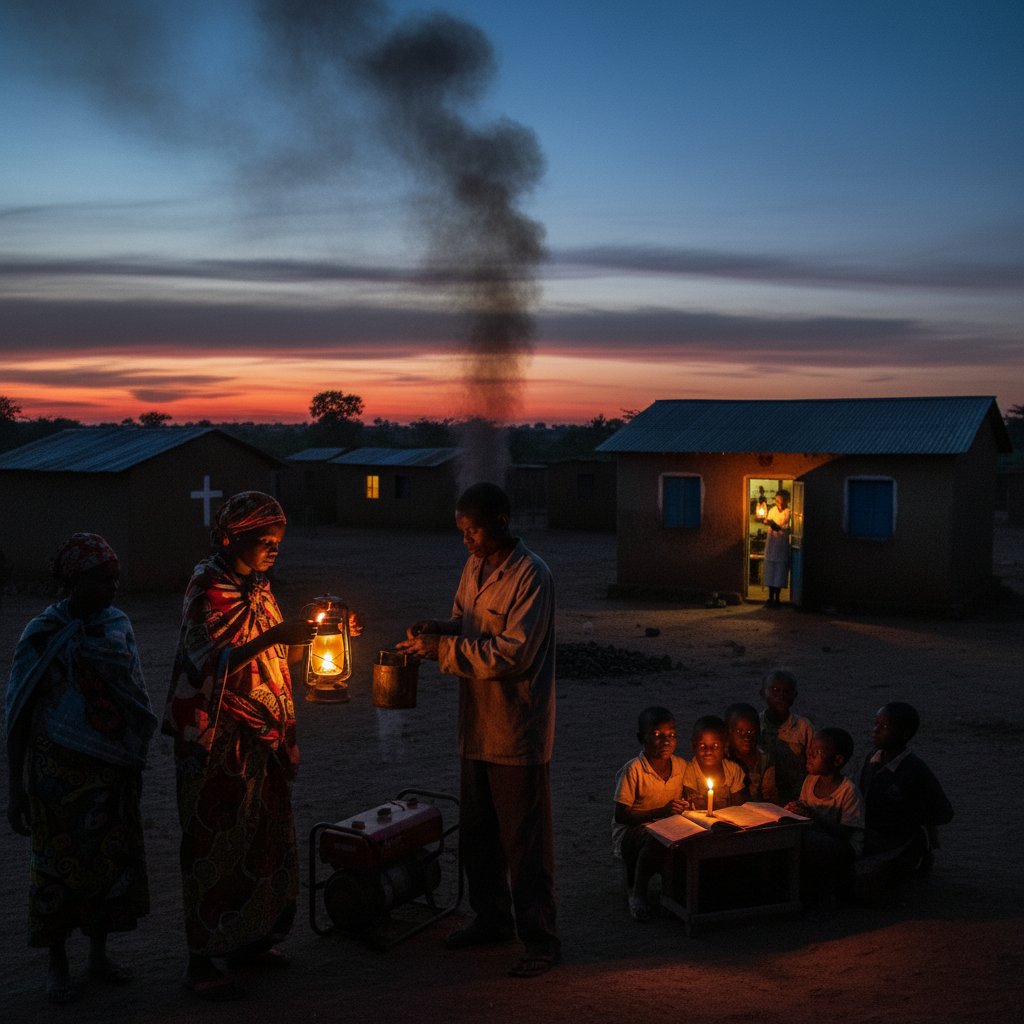
Energy poverty limits community development
Shared Renewable Power Systems
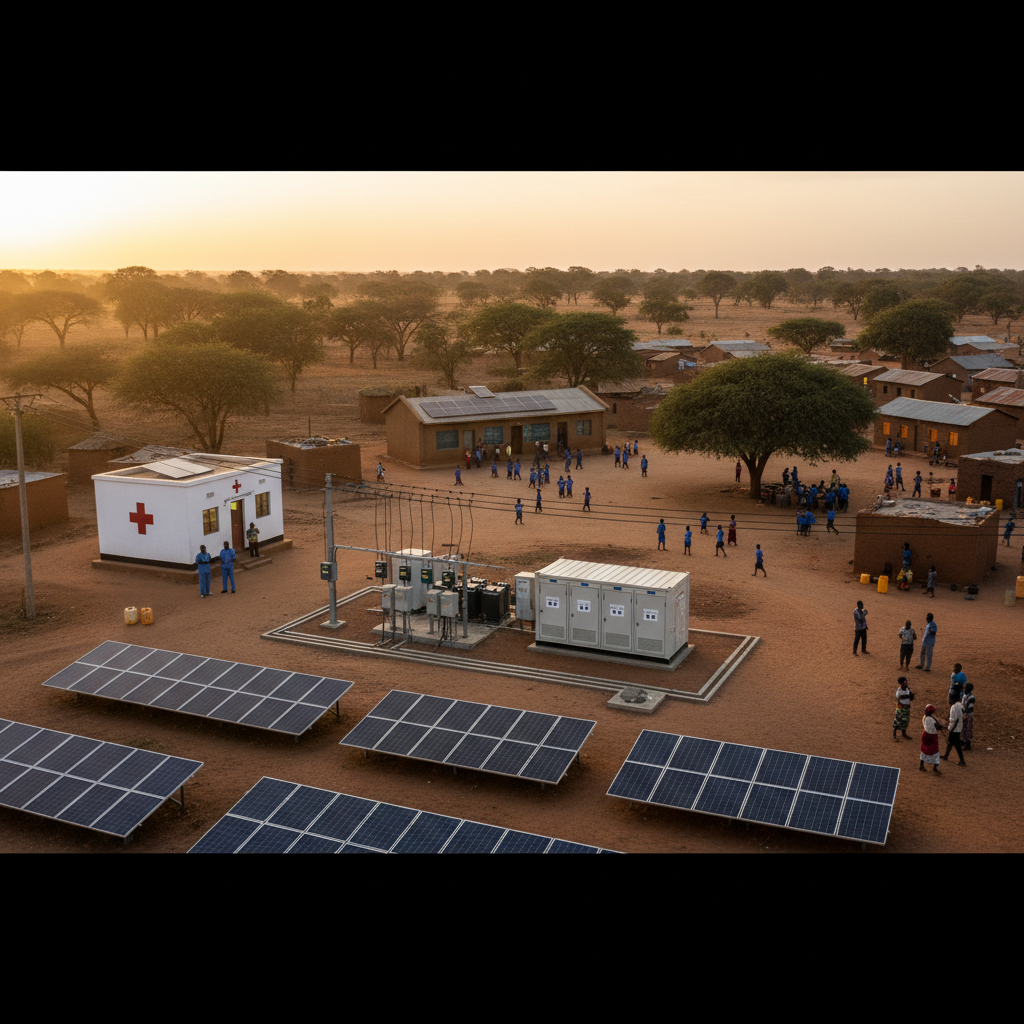
AHPI designs and deploys community-scale mini-grids that provide reliable, clean electricity to multiple institutions and households through shared infrastructure.
What AHPI Mini-Grids Deliver:
Solar-powered mini-grids
Modular solar arrays with centralized generation and distributed power delivery to multiple connection points
Battery storage and smart distribution
Advanced energy storage systems with intelligent load management ensuring 24/7 power availability
Systems sized for community and institutional needs
Capacity planning that prioritizes essential services while enabling economic activity and household connections
Every system is designed for reliability, scalability, and shared community benefit — creating energy infrastructure that enables long-term development.
What Mini-Grids Deliver
Every AHPI mini-grid creates measurable improvements in healthcare delivery, educational outcomes, economic opportunity, and community resilience.
Reliable Power for Essential Services
Clinics, schools, and water systems receive consistent electricity, enabling quality healthcare, education, and community infrastructure to operate without interruption.
Reduced Fuel Dependence
Communities eliminate reliance on expensive, polluting diesel generators, reducing operational costs and environmental impact while improving energy security.
Lower Long-Term Energy Costs
Solar mini-grids provide predictable, declining energy costs over time, freeing institutional budgets for core services and enabling household economic activity.
Improved Community Resilience
Reliable electricity strengthens community capacity to respond to health emergencies, climate shocks, and economic challenges through enhanced infrastructure.
Energy as a Catalyst for Development
Reliable electricity doesn't just power lights and equipment — it unlocks human potential and enables communities to build their own pathways to prosperity.
Enable Reliable Healthcare Delivery
Clinics can refrigerate vaccines, operate medical equipment, provide safe childbirth services, and deliver quality care 24/7 without power interruptions.
Support Education and Water Systems
Schools gain access to computers, lighting for evening study, and modern teaching tools, while water pumps provide consistent access to clean water.
Power Local Businesses and Livelihoods
Small businesses can operate refrigeration, power tools, and digital services, creating jobs and economic opportunity within the community.
Strengthen Community Resilience
Communities gain capacity to respond to emergencies, adapt to climate challenges, and build long-term development pathways through reliable infrastructure.
Mini-grids create a foundation for integrated development — where energy access enables progress across health, education, water, and economic opportunity.
Designed to Integrate
AHPI mini-grids are not standalone energy projects — they are designed as the backbone of an integrated development platform that connects multiple community systems.
How Mini-Grids Connect:
Connect clinics, schools, clean cooking, and water systems
Single energy infrastructure powers multiple community services, reducing costs and improving coordination
Form the backbone of AHPI's integrated platform
Mini-grids enable coordinated delivery of healthcare, education, water, and economic development services
Support long-term, scalable development models
Shared infrastructure reduces per-service costs and creates pathways for sustainable expansion as communities grow
By integrating energy with other essential services, AHPI creates development systems that are more efficient, sustainable, and responsive to community needs.
From Community Pilots to Regional Networks
AHPI's approach to mini-grid deployment is systematic and evidence-based, starting with carefully designed pilots and expanding through validated models.
Phase 1: Community Pilots
Initial deployments are anchored around clinics and essential institutions, demonstrating technical reliability and community benefit while building local capacity for operation and maintenance.
Phase 2: Model Validation
Pilots validate technical configurations, financial sustainability models, and community engagement approaches — generating evidence for what works and refining implementation strategies.
Phase 3: Regional Expansion
Validated models expand into regional and cross-border programs, creating networks of interconnected communities with shared technical support, financing mechanisms, and development coordination.
This phased approach ensures that every expansion is built on proven success, creating sustainable energy infrastructure that serves communities for decades.
Power Communities. Unlock Opportunity.
Support shared energy systems that enable long-term community resilience.